


Lower Connecticut River Valley Region Farms
Featured Farmer | Merrie Avallone | Dreamland Farm
Growing dahlias (as well as peonies, celosia, ranunculus, a large variety of perennials and shrubs for their flowers and ‘bouquet fillers’) incorporates Merrie’s love of color and the outdoors. She creates beauty with her own hands, and thrives on human connection, learning and teaching, organic and nutritive practices and, always, her passion.
Merrie’s customer base is paramount, and she intends to keep her farm small and manageable. She wears many hats, as most farmer-growers do, too. Sue is a part-timer and will be joined by another helper soon. The work schedule for herself is 6-7 days per week, year-round, with a 7-10 day break in July when she can.
Merrie originally moved to the area while teaching and never left. This is remarkable because her life in every other way has been one of shifts. There is nothing vanilla and predictable about it. She has encyclopedic interests and squeezes as much out of life as possible. ‘I am my product’, she says, and her devotion to making the best of every phase of her business is unquenchable. Dreamland Farm is not the largest dahlia producer in Connecticut, the most famous or the most lucrative, but Merrie may be the smartest operator of them all.
A visit to Dreamland Farm in early March is very different from visiting, say, in June. In summer, visitors have remarked, in awe, that the field of dahlias looks ‘like a dream’. In fact, that’s how the farm got its name.
On our visit in March, the property was covered in snow, punctuated with metal poles, each one topped with a tennis ball for safety. A tour of the workshop and learning about Merrie were the focus. Even among the variety of small market gardeners/farmers in the lower valley, this operation and its owner are unique.
Merrie has been growing dahlias for over twenty years. This followed periods of teaching art, creating a business selling her made-in-America polymer creations to gift shops all over the world, and developing a family nutrition practice. Looking back, there is not so much a single thread as consistent themes in her life. Her education included art and teaching, natural sciences and nutrition, the latter two at master’s level. This followed a childhood of intense, self-directed physicality-- backcountry canoeing, kayaking, skiing, outward bounding and more. If there was a physical challenge to be had, escaping the confines of her home with the promise of being outdoors, she was more than ready.

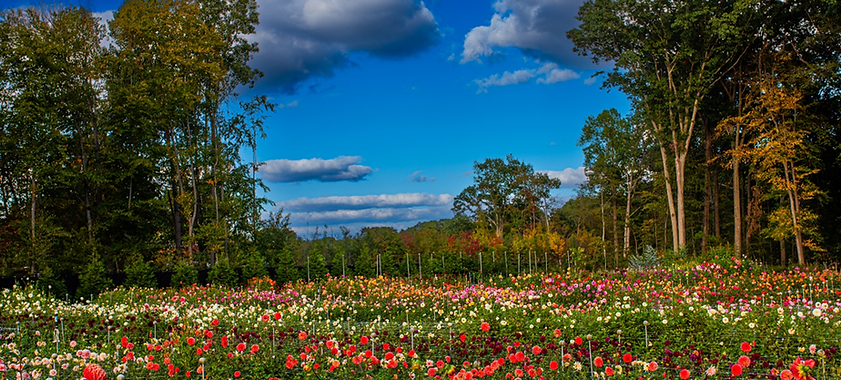
The farm’s location, a suburban street, has been here about 6 years. The land extends 5-1/2 acres and had been host to a trailer-RV repair business. Nothing from a drive-by would suggest its antecedents or current use. There is no sign and no pick-your-own. Most of her cut flowers are sold through the Connecticut Flower Collective in Middletown between May and October. She does operate a Flower Shack from the farm where she sells bunches starting at $30. It’s run on the honor system, accepting all forms of payment online, cash and Dreamland gift cards. The shack is usually open from mid-May through June on weekends. In late August it reopens, again on weekends, until mid-October.
Merrie takes on custom floral arrangements and wedding requests as well, and she is always available to her customers, regular and prospective. The nation- wide customer base is supportive of the wide and carefully curated selection of dahlia tubers. Sales of dahlia tubers begin in January and shipping begins in March. When her online tuber store opens, the customers are waiting and ready; the tubers often sell out early.
Merrie is truly a dahlia addict. Her enduring excitement about them is understandable. They come in a variety of colors, shapes, sizes and textures. The more you cut the blooms, the more the plant grows new ones. Dahlias reproduce naturally by underground tubers. Each plant creates a clump of tubers which are then divided after the plant dies back with the first or second frost. They’re stored over the winter in plastic bins of vermiculite in a temperature and humidity-controlled root cellar.
The extraordinary feature of dahlias is that what is grown above ground (the flower), while lovely and desirable, is less valuable--

a lot less valuable-- than what’s grown underground. These plants technically offer more than the two streams of reproduction here, the other being seed. Each stream of income for dahlias has their own techniques for selling and harvesting, requiring completely different approaches to eventually reach their buyers.
Dahlias are members of the aster family whose native home is the mountains of Mexico. They come in 42 recognized species, 65 varieties, all colors but blue and black, and sizes from little pompoms to dinner plates. They are reliably hardy in Zones 8 and above. Merrie grows about 4,000 plants on just under 2 cultivated acres. Her choices are governed by what tubers she already has on hand and what new ones she’s attracted to.

Dahlias are usually sold by individual tuber, each having at least one eye. Dividing a clump into multiple tubers takes patience, practice and a steady hand. Even storage requirements are specific. The labor is very much worth the effort, as each ‘baby’ commands a price of $8-45. Tuber size isn’t related to value, as a single eye will reproduce a plant. Some dahlia varieties always produce larger than average tubers, while others produce smaller ones. Some varieties produce clumps with lots of tubers while others produce very few.
A single, well-cared-for dahlia plant can produce anywhere from 10 to 25 blooms, and sometimes more, over the course of a growing season. These Merrie sells manly through the Flower Collective. The final tally of flowers is less about luck and more about strategy.
Think of a dahlia tuber not as a plant that will produce a set number of flowers but as a flower factory with incredible potential. Merrie’s job is to be the best factory manager she can be. She is an entrepreneur in the classic sense. Her personal attention builds customer trust, given Merrie’s control from beginning to end. She reaches out through newsletters, workshops, videos and seminars and in future will hire help to expand her social media presence.

In the end, Merrie embodies principles that seem to guide her life while embracing physical work and brain-power: a mission that matters; a handshake and her word are as important as a contract; you reap what you sow; and rigorous data–keeping are key.

Dreamland Farm’s success is testimony to the energy, attention to detail, knowledge base, human connection, and unflagging commitment of its founder. A few minutes spent with Merrie suggests that even the most prosaic task is a kind of miniature quest. She seems to be in a constant state of readiness that blurs any line between labor and private time. Her business is carefully constructed and forcefully sustained on organization and love. And the end product is simply beautiful. Long may Merrie, her family, and her farm flourish in Cromwell.

By Sandra Childress | August 2025
About the Author:
Visiting small farms has been the highlight of Sandra's travels in places as diverse as Normandy, France and central Vermont. It's not the battlefields and beaches, cathedrals and history in northern France. It's not the ski slopes, church spires and fall colors that linger in her memories of Vermont. It's the working landscapes and getting to know hardworking farmers that linger most. These are invariably visionary people, yet hands on in the eternal interplay of their labor, environment and the cycles of life.
Small organized groups make it possible to find farmers who will offer a glimpse of their philosophy and commitment to the land with travelers who appreciate it. Then there are the sights and smells, the fun of new life, the connection to seasons. But our Lower Connecticut Valley offers much the same experience closer to home. As a bonus, there's often a farm shop, offering the option to take home products straight from the farm. There couldn't be a nicer way to spend an hour or two in our own fertile valley and reconnect with a timeless-- if changing-- way of life.